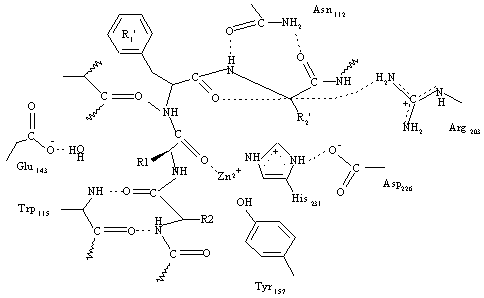
Thermolysin binds to inhibitors with large hydrophobic residues. An overview of the binding of substrates to thermolysin is illustrated below.
The substrate binds to thermolysin with the carbonyl oxygen of its peptide bond displacing a water molecule. The coordination of the carbonyl oxygen about the zinc ion is approximately tetrahedral. The carbonyl carbon is in close proximity to the side chain of Glu-143 and to the nitrogen of His- 231. On the carboxyl side of the scissile bond, the peptide bond joining R1' and R2' binds between Arg-203 and Asn-112. The carbonyl oxygen on this side hydrogen-bonds to Arg-203, while the nitrogen is in an excellent position to hydrogen bond to the amide oxygen of the side chain of Asn-112. The large R1' phenyl group is tightly packed in a hydrophobic pocket that is lined entirely by nonpolar sidechains. The backbone of residue R2 is in a position to form two hydrogen bonds to the protein backbone of Trp-115. The substrate residues, R2,R1, and R1' interact with the protein backbone between Trp-115 and Ala-113 in an antiparallel pleated sheet. The binding of inhibitors to thermolysin suggest that a number of groups participate in substrate binding and may also contribute significantly toward stabilization of the transition state. The figure above illustrates the hydrogen-bonded interactions of the substrate upon initial binding and in the transition state. All of the available hydrogen-bond donors and acceptors of the substrate appear to interact with the enzyme. Hydrophobic interactions are also important in forming the Michaelis complex and possibly in stabilizing the transition state. The largest contribution appears to come from the R1' side chain in the hydrophobic pocket. The interaction between R1 and Phe-114 appears to lower the free-energy barrier of the transition state for substrates in which R1 is hydrophobic and bulky.
Upon binding of substrates, Glu-143 becomes buried in a nonpolar environment along with a water molecule. The free-energy required to bury this group is provided by the favorable interactions described above. Under these conditions, Glu-143 becomes a strong base capable of abstracting a proton off a water molecule and mediating its attack upon the carbonyl carbon of the susceptible peptide bond. Formation of the tetrahedral transition state is promoted by a lowering of the free-energy of Glu-143 and the transfer of the charge to the zinc-bound oxygen. Thus, it appears that the initial "burial" of Glu-143 may be one of the driving forces of catalysis.
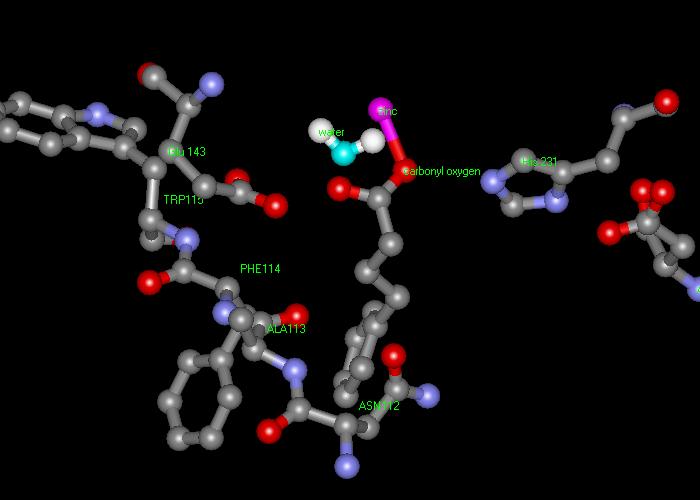
Binding of an extended substrate to thermolysin
The figure above illustrates the binding of an N-Carboxymethyl dipeptide with a phenylbutyl group. The carbonyl oxygen of the peptide bond binds directly to the zinc atom(shown above as pink) to make the zinc coordination approximately tetrahedral. The zinc is very important in stabilizing the transition state by electrostatic interaction with the negatively charged oxygen. The figure above displays the "burial" of Glu-143 in a nonpolar environment. The phenyl group of the peptide can be seen in the hydrophobic pocket, next to Phe-114. This interaction is believed to lower the free-energy barrier of the transition state. The binding of thermolysin inhibitors described above suggests a mechanism of action for the enzyme which is illustrated schematically below.

Following substrate binding, Glu-143 promotes the nucleophilic attack of a water molecule upon the carbonyl carbon of the peptide bond, which has already been depolarized by the zinc. His-231 is stabilized, through hydrogen-bonding, by the negatively charged oxygen from Asp-226. After attack of the water molecule, His-231 donates a proton to the peptide nitrogen, forming an intermediate which is tetrahedral at both the carbon and nitrogen of the scissile bond. This intermediate is stabilized by the hydrogen bonds with Glu-143 and His-231. The protonated nitrogen becomes a good leaving group as the carbon-nitrogen bond of the intermediate breaks to yield the products.Thus, thermolysin, like carboxypeptidase A, is very efficient in hydrolyzing peptide bonds.