Mechanism
The penicillin-binding-proteins (PBPs) are involved in the final stage of bacterial cell wall biosynthesis. The PBP-catalyzed hydrolysis leads to the formation of a serine-ester-linked acyl-enzyme intermediate. Marked by the D-Ala-D-Ala-carboxypeptidases, strands of peptidoglycan are hydrolyzed at the terminal D-Alanine residue. This initial step is accompanied by either the hydrolysis of the intermediate to generate a free D-Alanine terminus or transfer of the free amino terminus to another peptide chain, known as transpeptidation. Transpeptidation allows these acyl-enzyme intermediates to stabilize the bacterial cell wall against hypotonic lysis.
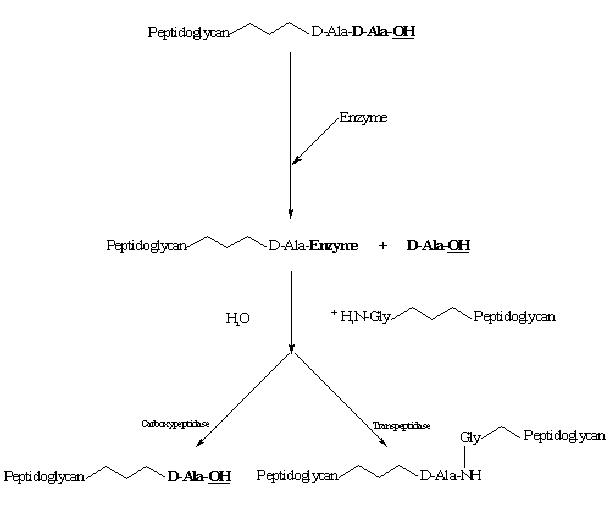 The process of bacterial cell wall synthesis. The strands of peptidoglycan are targeted by the D,D-carboxypeptidases, resulting in the hydrolysis of the terminal D-Alanine residue. The acyl-enzyme intermediate can then be deacylated by water or an amino acceptor, the latter resulting in a stabilized crosslinked structure (Richmond, 1994).
b-lactamases, undergoes a similar acylation by the b-lactam. However, unlike the previously mentioned penicillin-binding proteins, b-lactamases rapidly deacylate the penicilloyl complex, rendering b-lactam useless. The rate of deacylation of this acyl-enzyme intermediate resulting from interaction with b-lactam antibiotics with penicillin-binding-proteins is slow, therefore the bacterium is deprived of the biosynthetic function of these enzymes, an event that results in bacterial death.
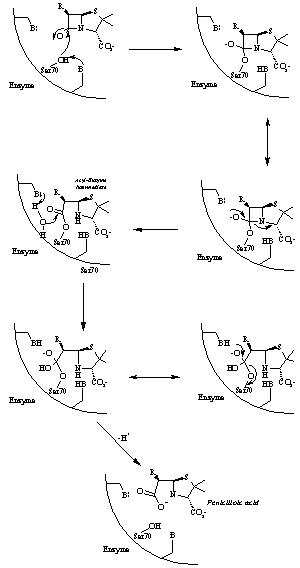
A mechanism for the hydrolysis of the b-lactam antibiotics by b-lactamase. The active site serine forms a acyl-enzyme intermediate with the antibiotics which is hydrolyzed by the transfer of a water molecule from Glu166 (Richmond, 1994)
On the basis of a similarity in the three-dimensional fold for class A and C b-lactamases with penicillin-binding-proteins, these proteins are believed to be related by a common ancestry (Bulyche, 1997). Even though the theory that the b-lactamases evolved from penicillin-binding-proteins was initially based on the substrate analogy, the penicillin-binding-proteins and the class A enzymes have also been shown to contain homologous sequences near the active site serine and have similar overall tertiary structure (Richmond, 1994).